Many people make financial decisions without fully understanding the tax, legal, or budgetary consequences of their choices. This game was created to help address that gap by making personal finance learning more fun, interactive, and accessible. Through gameplay, participants gain tools to better manage their money, plan for the future, and avoid costly mistakes.
Game Objective
The main goal is to test and improve your financial literacy through a variety of questions that encourage thought and conversation. Whether played at home, with friends, or at work with colleagues, the game provides a meaningful and enjoyable way to explore key financial concepts.
The game can be played with two or more players, making it suitable for small gatherings or larger group settings. There is no upper limit on the number of players.
How to Play
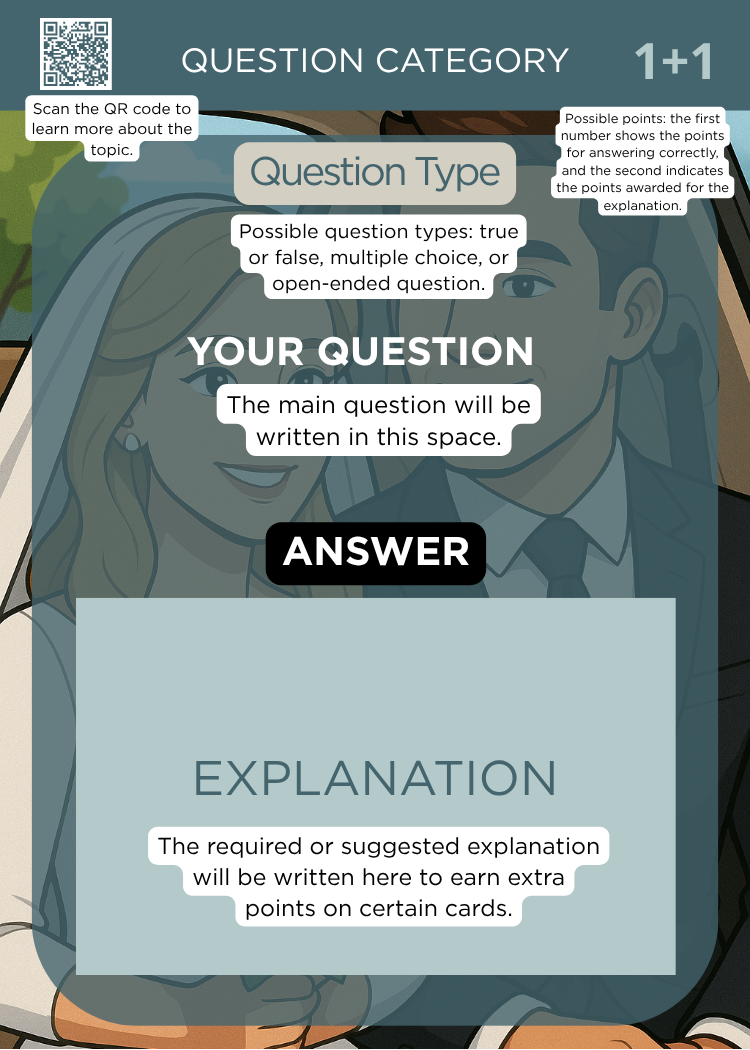
Players take turns. On each turn, one player draws a card and reads the question aloud to another player (not to themselves). The player being questioned answers the question and may provide a justification or explanation.
Then, the card is flipped over to reveal:
- The correct answer
- A brief explanation or justification
-
True or false
-
Multiple choice
-
Open-ended
Each card has two numbers printed in the top right corner:
Empty space, drag to resize
- The number of points awarded for a correct answer
- The bonus points for a good justification
If a card says 2 | 1, that means the player earns 2 points for a correct answer and 1 bonus point for a clear and accurate explanation.
The goal is to accumulate as many points as possible by answering questions correctly and demonstrating a strong understanding.
Cards are divided into five key themes, each addressing an important aspect of financial literacy:
Learn how credit works, what affects your credit score, how loans and lines of credit function, and strategies to reduce or avoid debt.
Understand different types of investments (stocks, bonds, GICs), basic investing principles like risk tolerance and diversification, and how investment income is taxed.
Develop good habits for managing income and expenses, building an emergency fund, setting priorities, and defining financial goals.
Demystify registered plans like RRSPs and TFSAs, retirement income strategies, tax brackets, and government benefits
Explore topics such as wills, powers of attorney, protection mandates, estate planning, marital rights, and legal obligations related to taxes and inheritance.
Before starting, players should agree on one of the following:
-
A set number of cards to play (e.g., 20 cards)
-
A target score to reach (e.g., 30 points)
At the end of the game, the player with the highest score wins.
This game turns important financial knowledge into an engaging experience. By blending learning with play, it helps players strengthen their decision-making skills and understand complex concepts in a practical, enjoyable way.
Whether you're brushing up on tax rules, reviewing credit basics, or exploring estate planning, the game fosters a better understanding of real-life financial scenarios. It promotes discussion, critical thinking, and confidence, empowering individuals to make better choices and avoid common pitfalls. Ultimately, it’s a fun and powerful tool for improving personal finance literacy—one question at a time.