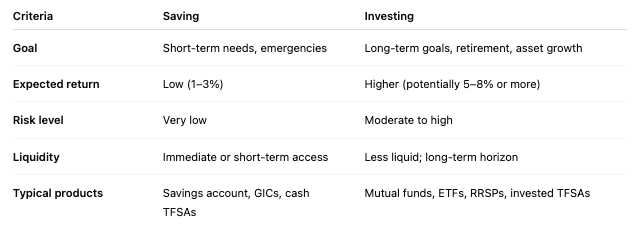
In everyday conversation, the words saving and investing are often used interchangeably. However, they represent two very different financial strategies, with distinct purposes, time horizons, and levels of risk. To build a strong financial foundation, it's essential to know when to save, when to invest, and why each plays a role in your financial plan.
What Is Saving?
Saving means putting money aside in a safe, low-risk, and easily accessible account, such as a high-interest savings account, chequing account, or short-term GIC (Guaranteed Investment Certificate).
Purpose: Safety and Liquidity
Savings are mainly used for:
-
Unexpected expenses (car repairs, job loss)
-
Short- or medium-term goals (vacations, car purchase, down payment)
-
Building an emergency fund
The goal is to protect your capital, even if the return is modest. Saving gives you short-term financial security and helps you avoid relying on credit in emergencies.
If you need the money within the next 0–3 years, it should be saved—not invested.
Investing involves putting your money to work to grow it over the long term, by accepting some level of risk. Common investment options include:
Investments are best suited for goals such as:
Investments may fluctuate in value over time, but historically, they offer higher long-term returns than savings.
Saving $500/month at 2% in a savings account gives you about $33,000 after 5 years. Investing that same amount at a 6% return would yield nearly $35,000. After 15 years, the difference is even more dramatic.
Saving and investing are not mutually exclusive—they’re complementary tools. Saving gives you flexibility and resilience, while investing helps you achieve your long-term ambitions.
- Build an emergency fund equal to 3–6 months of essential expenses (in a savings account)
- Save for short-term goals using secure, low-risk products
- Invest regularly for long-term goals like retirement, using tax-advantaged accounts (RRSP, TFSA, etc.)
Saving is about preserving. Investing is about growing. Knowing when to do each—and how to balance the two—will help you navigate your financial life with confidence. A strong financial plan doesn’t choose between saving or investing: it strategically blends both to meet your needs today and build your future.